How we teach Phonics
At St Mary’s Primary school we use the Ruth Miskin Read Write Inc. phonics programme (RWI) for children in Reception, Year 1 and 2. Some children in years 3 and 4 who require phonics will also have access to the programme.
What is Read Write Inc.?
Read Write Inc. (RWI) is a systematic, synthetic phonics programme, designed to help all children learn to read fluently and confidently so they can focus on developing their comprehension, vocabulary and spelling skills.
How will RWI be taught?
All children are assessed half termly by the Reading Leads, meaning they work alongside other children at the same stage of reading development. This ensures full participation and allows each child to learn at the pace that is right for them.
Children have daily RWI lessons from Reception through to Year 2. When our Year 2 pupils are reading they move to ‘Fluency Group’.
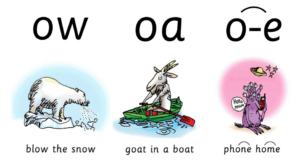
Each Speed Sound (letter sound) is taught using a picture and a memorable phrase to help children recall it easily.
Alongside these sounds, children are introduced to:
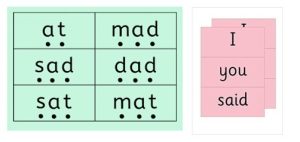
- Green Words – decodable words that can be sounded out.
- Red Words – common exception words that cannot be sounded out and must be learned by sight.
Reception
In Reception, children begin by learning one letter sound per day, always using pure sounds to support blending.
For example:
- “Maisie, mountain, mountain” becomes the pure sound m
- “t‑t‑t‑tower” becomes the pure sound t
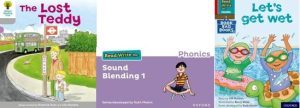
In the Autumn Term, children in Reception are taught whole class by their own class teacher while they build confidence. From Spring onwards, following assessment, they will move to smaller RWI groups taught by EYFS staff members. Initially children will come home with wordless books before moving on to sound blending books and then the RWI home reader linked to their current group.
By the end of Reception, children learn:
- All Set 1 Speed Sounds
- How to blend sounds to read words
- At least ten digraphs (two letters that make one sound), known as Set 2 Speed Sounds
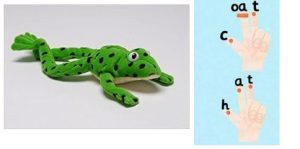
Teachers frequently use Fred Talk (e.g., c‑a‑t → cat) to model blending.
Children also use Fred Fingers to segment words for spelling.
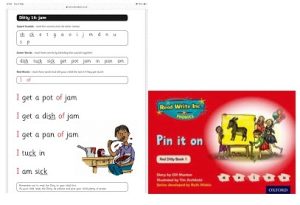
Children read RWI texts that match their phonics stage. They begin with Ditties (short phonics-based texts) before progressing to storybooks as their confidence grows.
They also learn and practise Red Words (common exception words) regularly.
Year One & Year Two
Children follow the same RWI lesson structure but learn:
- More complex sounds (Speed Sounds Sets 2 and 3)
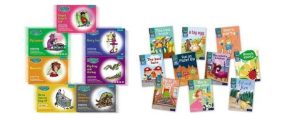
- Longer, more challenging phonics storybooks
Once children are fluent readers, they transition to the ‘Fluency Group’.
Children will bring home the RWI home reader linked to their current group. Once they reach Fluency Group, they will bring an ‘easy reader’ home from the school library.
Set 1 Speed Sounds and Rhymes
| Sound |
Rhyme |
| m |
Down Maisie then over the two mountains. Maisie, mountain, mountain. |
| a |
Round the apple, down the leaf. |
| s |
Slide around the snake. |
| d |
Round the dinosaur’s back, up his neck and down to his feet. |
| t |
Down the tower, across the tower. |
| i |
Down the insect’s body, dot for the head. |
| n |
Down Nobby and over the net. |
| p |
Down the plait, up and over the pirate’s face. |
| g |
Round the girl’s face, down her hair and give her a curl. |
| o |
All around the orange. |
| c |
Curl around the caterpillar. |
| k |
Down the kangaroo’s body, tail and leg. |
| u |
Down and under the umbrella, up to the top and down to the puddle. |
| b |
Down the laces, over the toe and touch the heel. |
| f |
Down the stem and draw the leaves. |
| e |
Slice into the egg, go over the top, then under the egg. |
| l |
Down the long leg. |
| h |
Down the horse’s head to the hooves and over his back. |
| sh |
Slither down the snake, then down the horse’s head to the hooves and over his back. |
| r |
Down the robot’s back, then up and curl. |
| j |
Down his body, curl and dot. |
| v |
Down a wing, up a wing. |
| y |
Down a horn, up a horn and under the yak’s head. |
| w |
Down, up, down, up the worm. |
| th |
Down the tower, across the tower, then down the horse’s head to the hooves and over his back. |
| z |
Zig‑zag‑zig, down the zip. |
| ch |
Curl around the caterpillar, then down the horse’s head to the hooves and over his back. |
| qu |
Round the queen’s head, up to her crown, down her hair and curl. |
| x |
Cross down the arm and leg and cross the other way. |
| ng |
A thing on a string. |
| nk |
I think I stink. |
Set 2 & 3 Speed Sounds
Once children are secure in all Set 1 sounds and can blend confidently, they move to Sets 2 and 3, which teach long vowel sounds and alternative spellings.
Example: Long Vowel Sounds
| Long Vowel |
Set 2 (Taught First) |
Set 3 (Alternative Spellings) |
| a |
ay: may I play |
a‑e: make a cake / ai: snail in the rain |
| ee |
ee: what can you see |
ea: cup of tea / e: he, me, we |
| igh |
igh: fly high |
i‑e: nice smile |
| ow (long) |
ow: blow the snow |
o‑e: phone home / oa: goat in a boat |
| oo (long) |
oo: poo at the zoo |
u‑e: huge brute / ew: chew the stew |
| oo (short) |
oo: look at a book |
— |
| ar |
ar: start the car |
— |
| or |
or: shut the door |
aw: yawn at dawn |
| air |
air: that’s not fair |
are: share and care |
| ir |
ir: whirl and twirl |
ur: nurse for a purse / er: a better letter |
| ou |
ou: shout it out |
ow: brown cow |
| oy |
oy: toy for a boy |
oi: spoil the boy |
| ire |
— |
ire: fire, fire! |
| ear |
— |
ear: hear with your ear |
| ure |
— |
ure: sure it’s pure? |
Useful Links for Parents
How to pronounce Speed Sounds:
https://www.oxfordowl.co.uk/for-home/reading-owl/find-a-book/read-write-inc-phonics–1/phonics-pure-sounds-video
Free RWI Resources for Home:
Oxford Owl offers eBooks, practice sheets, videos and more:
https://home.oxfordowl.co.uk/reading/reading-schemes-oxford-levels/read-write-inc-phonics-guide/
Reading at Home
Hearing your child read their ‘home reader’ aloud is an invaluable way to support their reading development. When children re-read the same text, they build both their reading speed and their ability to use a natural, expressive ‘story voice’. As decoding becomes easier, their confidence, enjoyment, and fluency all increase.
We encourage parents and carers to listen to their child read aloud at least four times a week. Re-reading their ‘home reader’ is especially beneficial, as it helps build confidence and supports children in becoming fluent, enthusiastic readers.
Alongside this, we of course encourage children to choose other books that interest them, either to read themselves or for you to read to them. Hearing and sharing stories is hugely powerful in developing a lifelong love of reading.
The Year 1 Phonics check
Children in Year 1 take part in the Governments Phonics Screening Check during the month of June. This check is an informal task carried out 1:1 with a teacher to provide information that the children are making progress within phonics to become a fluent reader. It is a list of 40 words presented as real words and pseudo (alien) words (e.g. brip, snorp) to see if children are using their phonics to read the words. It takes no more than 5-10 minutes.
The check will identify the children who need extra help so they are given support by their school to improve their reading skills. These children will then be able to retake the check in Year 2 so that the school can track them as they move through the school.
Useful websites:
Ruth Miskin RWI https://www.ruthmiskin.com/en/find-out-more/parents/
Oxford Owl (Your child will receive a login to read RWI ebooks online) https://www.oxfordowl.co.uk/please-log-in
Additional Information:
Parent Booklet 1
Parent Booklet 2
Speed and Sound Chart
Set 1
Set 2
Set 3